
A Polymarket clone script is the fastest, most cost-effective path to launching your own decentralized prediction market platform, without 6 to 12 months of custom development. Decentralized prediction markets are quickly turning into a mainstream financial technology. They allow traders to place bets on the outcome of real-world events such as politics, sports, and economic data using blockchain-based smart contracts.
The timing is ideal. Institutional interest in prediction markets has moved from theoretical to active, regulatory barriers in key markets are being dismantled, and real on-chain liquidity now exists at scale. For crypto exchanges, Web3 startups, and fintech businesses, the gap in the market is not demand it is well-built, trustworthy platforms. Our Polymarket clone script gives you the infrastructure to fill that gap, with a fully audited, white-label solution that can be customized, branded, and deployed in weeks.
What is a Polymarket Clone Script?
A Polymarket clone script is a ready-to-deploy software solution that replicates Polymarket’s core architecture enabling businesses to launch a fully functional decentralized prediction market without building from scratch. It includes the complete technical stack required to operate at scale:
- Smart contract infrastructure for market creation, execution, and settlement
- Automated Market Maker (AMM) algorithms for dynamic, real-time pricing
- Oracle integration for verifiable real-world event data feeds
- Settlement and automated payout mechanisms
- User trading interface and portfolio dashboard
- Admin control panel and market management tools
The solution supports automated market creation, dynamic odds calculation, cryptocurrency-based trading, and transparent on-chain settlement — across a wide range of real-world event categories including politics, crypto, finance, sports, and entertainment. With full white-label customization, businesses can deploy a fully branded platform aligned with their specific business model and target audience.
Polymarket Platform — Key Statistics
Before building a Polymarket-style platform, understanding the benchmark you’re competing with is essential. Here are the key figures that define the Polymarket platform:
| Feature | Polymarket Platform Details |
| Platform Type | Decentralized, blockchain-based prediction market enabling global event trading. |
| Market Settlement | Instant settlement after event resolution through smart contract execution. |
| Withdrawal Speed | Typically processed within minutes depending on network confirmation. |
| Mobile Accessibility | Dedicated mobile applications available for both iOS and Android devices. |
| 7-Day Market Volume | Approximately $1.7 billion in trading activity across prediction markets. |
| Liquidity | High liquidity across trending and major event markets. |
| Trading Fees | Around 0.01% (1 basis point) based on total contract premium on US platform. |
| Core Advantage | Transparent on-chain trading powered by blockchain infrastructure and automated settlement. |
How a Polymarket-Style Prediction Market Platform Works
A Polymarket-style platform operates on blockchain-based smart contracts and real-world data feeds, allowing users to trade on the outcomes of future events. Every market is transparent, automated, and trustless eliminating the need for a central authority.
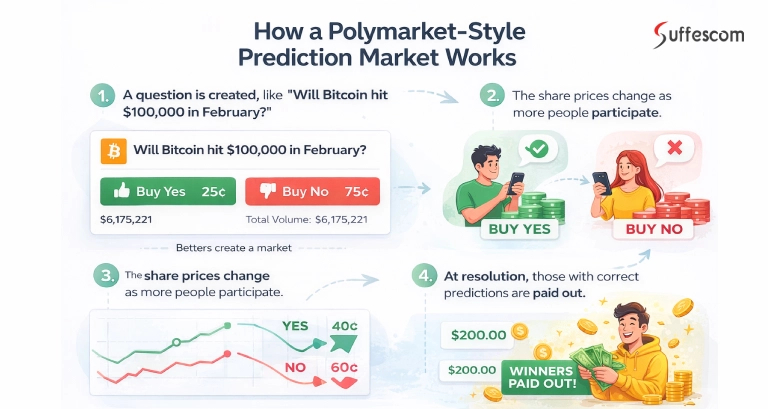
1. Event Market Creation
Platform administrators or approved market creators establish prediction markets with clearly defined binary (Yes/No) or multi-outcome events. Each market is deployed as an independent smart contract on the blockchain, embedding:
- Event description and resolution criteria
- Trading parameters (fees, expiration dates)
- Settlement logic and payout mechanisms
- Oracle data source specifications
This smart contract architecture ensures transparent rules, immutable market conditions, and predetermined settlement logic that cannot be altered after deployment.
2. Outcome Tokens & Pricing
For each possible event outcome, the system mints corresponding outcome tokens (e.g., “YES” and “NO” tokens for binary markets). The market price of these tokens represents the implied probability of that outcome occurring, as determined by collective market sentiment.
Example: If YES tokens trade at $0.65, the market implies a 65% probability of that outcome.
Price Discovery
As users buy or sell outcome tokens, prices adjust dynamically through the AMM algorithm based on:
- Current supply and demand
- Available liquidity in the pool
- Trading volume and velocity
- Market depth
3. Automated Market Maker (AMM)
The AMM serves as the algorithmic liquidity provider and price discovery mechanism, replacing traditional order book systems.
Core AMM Functions:
- Continuous liquidity: Enables trading at any time, even during low-activity periods
- Dynamic odds calculation: Updates prices in real-time based on trading activity
- Slippage management: Calculates price impact for large trades
- Liquidity pool rebalancing: Maintains market equilibrium across outcomes
4. User Trading & Liquidity
Users connect their crypto wallets, fund their accounts, and trade outcome tokens. Liquidity pools support continuous trading, while smart contracts securely handle all transactions.
Trading Workflow
- Users connect Web3 wallets (MetaMask, WalletConnect, Coinbase Wallet)
- Fund accounts using supported cryptocurrencies or stablecoins (USDC, USDT, DAI)
- Browse active markets and select events
- Purchase outcome tokens representing their prediction
- Hold tokens until event resolution or sell early to realize gains/losses
Liquidity Provision
Liquidity providers (LPs) deposit capital into market pools and earn:
- Trading fee revenue (typically 1-2% per trade)
- Potential arbitrage opportunities
- Platform incentive rewards
All transactions are executed through smart contracts, ensuring secure, transparent, and non-custodial trading.
5. Oracle-Based Event Resolution
When an event concludes, the platform must determine the correct outcome through decentralized oracle networks that provide verifiable real-world data.
Oracle Resolution Process:
- Event reaches expiration timestamp
- Smart contract requests outcome data from oracle network(s)
- Multiple oracle nodes fetch data from verified sources
- Consensus mechanism validates the correct outcome
- Oracle submits verified result to the settlement smart contract
Oracle Security Measures:
- Multi-oracle redundancy to prevent single points of failure
- Reputation-based oracle selection
- Dispute resolution mechanisms for contested outcomes
- Time-locked settlement periods allowing challenge submissions
6. On-Chain Settlement & Payouts
Settlement Mechanism
Upon oracle confirmation of the event outcome:
- Smart contract marks the market as “resolved”
- Winning outcome tokens become redeemable for the full payout amount (typically $1 per winning token)
- Losing tokens become worthless
- Users claim winnings by redeeming tokens through the smart contract